Coming in Hot
Neologisms, inflation, and how long is "transitory" anyway?

Neologisms: New words or phrases that have crept into the English language recently and may or may not be found in dictionaries.
Rice University has a Neologisms Database that’s home to over 5500 neologisms collected over the years by students in their English and Linguistics department. While many of these may be local colloquialisms and not reflective of changing uses nationwide, let alone worldwide, it is interesting to see how language continues to evolve.
Comin’ in hot: verb, compounding - Comin’ in hot means moving too fast in terms of bringing thoughts or ideas up too soon or prematurely. Comin’ in hot is used when someone is thinking too far ahead or prematurely brings up ideas.
Ex “That girl was comin’ in hot when she talked about marriage on the first date!”
The release last week from the Bureau of Labor Statistics on the Consumer Price Index (CPI) for April had market and economic commentators comin’ in hot with their own takes on the inflation numbers.
For the record: The Consumer Price Index for all Urban Consumers (CPI-U) rose 0.8 percent for the month of April after rising 0.6 percent in March. Over the last 12-months, the all items index increased by 4.2 percent which is the largest 12-month increase since September 2008, when prices rose by 4.9 percent over the prior year.
April’s CPI-U number was hotter than expectations by a factor of four (0.2% vs. 0.8%), and was the largest year over year increase in over a decade has people wondering if it’s going to be the seventies all over again.
Let’s put things into perspective; the next few months year over year inflation calculations are using a “base rate” from last year when the economy was in lockdown. March, April, and May last year saw consecutive declines in the all-items index (CPI-U) as the economy came to a standstill. With this as your starting point, expect year over year inflation numbers to be elevated for the next couple of months.
April’s report also had an unusual confluence of events; the re-opening accelerated as more Americans got vaccinated, checks from the $1.9T American Rescue Plan landed in bank accounts, pent up demand for travel and leisure sent hotel room and airline prices higher, there were global supply chain bottlenecks, and production badly lagged behind the surge in demand.
Highlighting several of the above was the increase in used car prices; new car production was hampered by the lack of computer chips out of Taiwan, and consumers armed with the latest round of stimulus checks looked for alternatives to public transportation.
The index for used cars and trucks rose 10.0 percent in April. This was the largest 1-month increase since the series began in 1953, and it accounted for over a third of the seasonally adjusted all items increase.
If you were to extrapolate this trend, the implication is that used car prices would more than double over the next year. Obviously not a base case scenario.
We won’t have a clear line of sight on the true inflation picture until towards the end of the year when most of the noisy corona related data falls off.
As the economy comes back online global supply chain issues should be resolved, demand will ease back to trend, and production will be normalized. That’s the baseline scenario. And for right now the market seems to agree.
The chart below shows the market’s inflation expectations for the next five years (blue: 5-year breakevens), and the five years after that (purple: 5-year 5-year forwards).
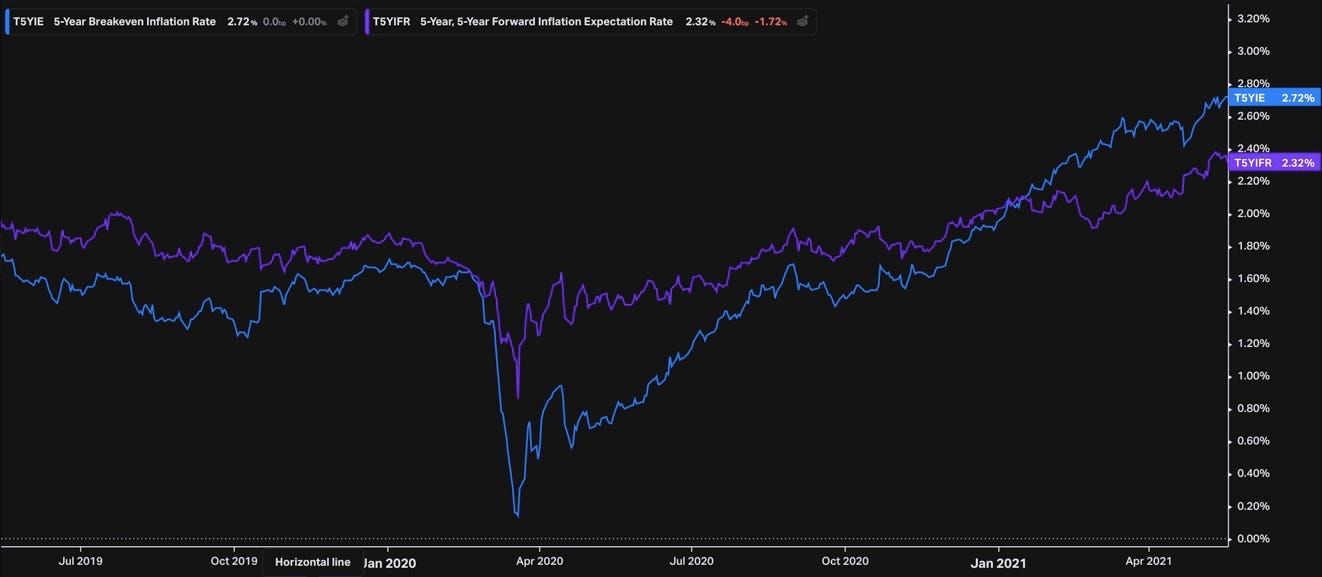
Market based indicators suggest inflation should run about 2.72 percent for the next five years, then moderate to 2.32 percent in the following five years. This is something to watch. If longer term measures move higher, that would indicate anchored inflation expectations may have become unmoored.
If we see high readings persist through the end of the year, the transitory thesis gets called into question and we’ll expect to see a shift in messaging from the Fed. Even now there’s initial discussion about scaling back ongoing purchases ($80B in treasuries and $40B in mortgages per month) which would be the first step towards eventually raising rates.
For now however the Fed is willing to be patient; Chair Powell believes high inflation will be transitory due to temporary pains in re-opening the economy. Despite whatever the headline numbers are in the next few months, I don’t believe they change will their position.
That’s not to say there’s no risk of inflation heating up. We’ve had six consecutive months of rising consumer prices (CPI-U); too soon to call it a trend, but this is how trends start.
Wages are rising around the country, both small businesses and large corporations are doing so independently to attract and retain talent. Should rising wages leading to rising prices become the norm, this circular dynamic becomes a problem that’s painful to fix.
Over the next few months expect to see the following headline topics:
Contentious debates over raising both the capital gains tax and income tax for high earners
Increasing debt ceiling (Politicians favorite pastime)
Tapering of asset purchases by the Federal Reserve
The fate of two ambitious spending bills: the American Jobs Plan and the American Family Plan.
As we enter year two of this recovery, the data over the next few months will have lots of noise, and it wouldn’t be shocking to see increased volatility and market weakness.
After an almost 90 percent rally from the March ‘20 lows, we are probably due for a pause and a 10+ percent correction wouldn’t be that unusual. In addition to the looming issues sighted above, fear of inflation may be just another excuse for investors to reset expectations before the next leg higher.
Inflation may be comin’ in hot, it’s just premature to say it’s more than transitory.