What a Diff'erence
Rising stock prices, falling inflation, and a resilient economy has changed the narrative

What a difference a day makes
24 little hours
Brought the sun and the flowers
Where there used to be rain
My yesterday was blue, dear
Today I'm a part of you, dear
My lonely nights are through, dear
Since you said you were mine
-What a Diff’rence a Day Makes, made popular by Dinah Washington, was originally written in Spanish by Mexican songwriter María Grever in 1934 with English lyrics created by Stanley Adams in 1939
While it’s been more than a day - hat tip to the lovely Dinah Washington - the rapid narrative shift in the economy’s prospects has been remarkable.
Only a few weeks ago, a survey of economists by Bloomberg believed there was a 77 percent probability that the economy would tip into recession in 2023. The forecasting model used by Bloomberg’s economists even predicted a 100 percent recession probability.
However, on the heels of a furious 14 percent equity market rally, there was a palpable shift in that narrative. Analysts began discussing the possibility of a soft landing, a scenario where rate hikes slow growth enough to curb inflation without a surge in unemployment or an economic contraction.
Following a series of unusually strong economic news in January - 500,000 jobs created, retail sales growing by 3.4 percent, signaling a strong consumer, and inflation falling for seven consecutive months - there are some now suggesting that, to stay with the airplane metaphor, the plane is re-accelerating and will remain at cruising altitude.
As hard as that is to believe, and it is, something else curious happened as we entered the month of February. After three unsuccessful attempts (red arrows) to break the longstanding downtrend (white line) in place since last year, the fourth surge succeeded (green arrow), signifying a potential change in trend.
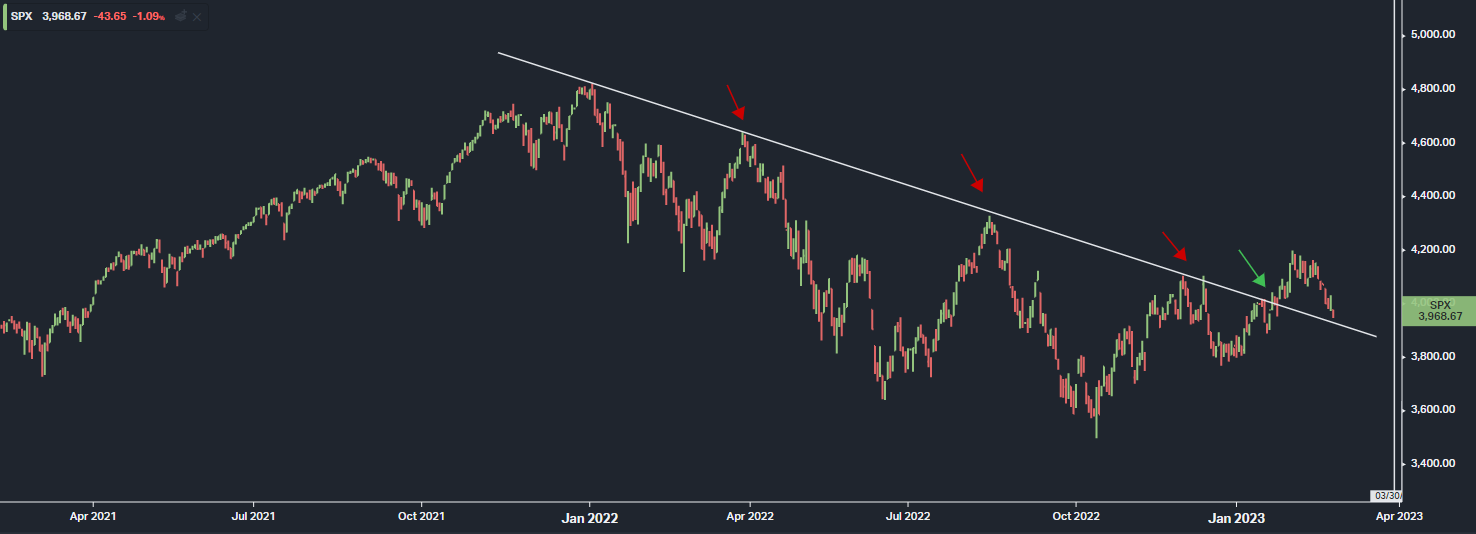
Notably, the fourth attempt coincided with a breadth thrust. A breadth thrust is a rare phenomenon in which many stocks participate in the upward movement over a very short period.
Specifically, in this instance, the percentage of stocks in the Russell 3000 making 20-day highs went from 6.6 percent on January 30 to 57 percent on February 2. That’s a lot of stocks making short-term highs all at once, indicating strong internal stock market momentum.
In the past, such a sudden change in market participation has provided escape velocity from prevailing downtrends, though it remains to be seen how this surge will unfold.
The challenge now is that stocks aren’t cheap anymore. At October’s market lows, the S&P 500 was valued at around 15x forward earnings estimates, slightly below the 30-year average of 16x. Fast forward to the February highs, and we find the S&P 500 trading around 19x forward earnings.
Now, stocks didn’t become expensive simply by rallying 17 percent from October’s lows. Earnings estimates - the E in the Price/Earnings Ratio - has actually fallen over the last few months. Expected earnings for this year have fallen from $238 in October to $219 today, an 8 percent decline. Falling earnings estimates are not what the Bulls want to see.
While the fourth quarter earnings season wasn’t as dreadful as some predicted, it certainly wasn’t anything to brag about. With earnings season almost over (94 percent of companies have reported), only 68 percent have beaten estimates for the fourth quarter, much less than the 77 percent beat rate over the last five years.
Moreover, the magnitude of earnings beats has been anemic this quarter. S&P 500 companies reported earnings that are, on the whole, 1.2 percent better than expectations; the five-year average is 8.6 percent. It’s better than nothing, but not by much.
So we’re left with a market that looks like it’s changed its dominant trend (still to be determined), is moderately expensive, earnings are uninspiring at best, and an economy that’s still cruising along.
It’s a scenario that likely sets up for a range-bound market: weak earnings but no collapse; a resilient, though not booming, economy; and generally declining inflation with occasional flare-ups. A lack of upward earnings revisions will keep a ceiling on the market, and an economy that refuses to roll over should keep a floor on any declines.
It may not be satisfying, but it’s the market we have for now.